ANIMAL SURGERY IS BACK IN Somali ecosystem

Somaliland has approximately 19 Million of livestock (camel, cattle, sheep and goat), and livestock contribute about 60 % GDP of the country. Therefore livestock is main source of income for Somali people. Unfortunately, the collapse of former Somali government resulted abandoned veterinary service and depletion of skilled veterinarians and veterinary surgeon.

Introduction of IGAD SHEIKH TECHNICAL VETERINARY SCHOOL(ISTVS), a regional veterinary institution revived  livestock veterinary services in Somali ecosystem by providing well trained veterinary personnel throughout Somali ecosystem.

Recently, ISTVS clinic section performed several surgical operations including Rumenotomy, caesarean section, hernia repairing and castration to livestock especially on goats.

These kind of activities were absent in the country for nearly three decades but today ISTVS has skilled personal and materials needed to carry out these major surgeries.

Plastic bags and consumption of foreign materials is common problem among the livestock in Somali ecosystem and the most suitable treatment intervention is by removing plastic bags from the rumen (stomach) hence Rumenotomy (stomach surgery) is best option. Therefore, ISTVS can now save animals from the tragedy of plastic bags and foreign material in their stomach.

Previously, livestock were dying for dystocia (difficult of birth) because there were no skilled Veterinary surgeon who could help deliver fetus through surgery luckily ISTVS has got a competent veterinarian who can perform such operations.

Apart from the importance of these operations to the community, ISTVS students were also participating and grasping these activities.

Dr Abdideeq Mohamed Yusuf (one of the ISTVS-Makerere Graduate who recently joined back to ISTVS) was the lead surgeon of these operations.

ISTVS, Sheep, Small ruminants, Somaliland| Tags: , ,

Somaliland: Livestock Trade Accounts for 40% of GDP, Earns country 80% Forex-ILRI Study

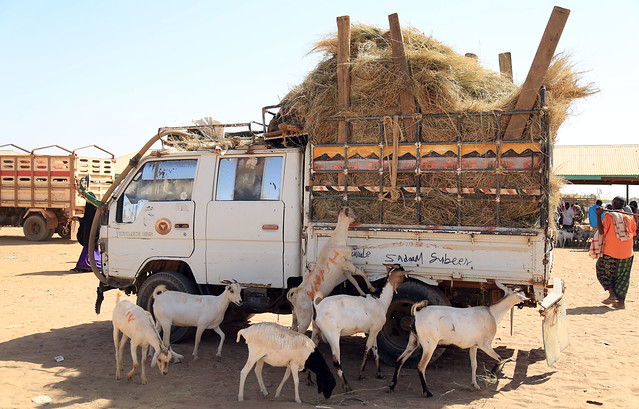
Goats feeding from feed truck

By Andrew Wangili

A recently published International Livestock Research Institute (ILRI) research brief shares findings from an assessment of animal grading and market participation among sheep and goats producers that show women are an integral part of livestock ownership and enterprise in Somaliland.

Livestock trade accounts for 40% of Gross Domestic Product and is also a chief forex earner (80%) in Somaliland. Sheep and goats are reared and traded in most parts of the country. In 2012, over 3 million sheep and goats worth USD 200 Million were exported. Saudi Arabia, Yemen, Oman, Egypt and the United Arab Emirates are the main importers.

A significant number of small ruminants are also marketed domestically creating jobs for locals especially women who are popularly involved in domestic meat selling and production of useful by-products such as soap and ornamentals. Income from livestock sales is used to buy food and other necessities thus impacting directly on food security and poverty.

ILRI’s researchers Francis Wanyoike, Nadhem Mtimet, Nicholas Ndiwa and Karen Marshall, together with Lawrence Godiah from Terra Nuova and Ahmed Warsame from the IGAD Sheikh Technical Veterinary School (ISTVS), analyzed livestock sales, producer’s awareness, exploitation and experience with the indigenous livestock grading system used in livestock markets among men and women in 144 households from 12 settlements in Hawd pastoral, West Golis pastoral and Togdheer agro-pastoral livelihood zones in Somaliland.

According to the brief, small ruminant enterprise households keep about 50 animals and flock sizes are larger among pastoralists (on average 58-72 animals) than among agro-pastoralists (29 animals) and women are also strongly involved in these enterprises as animal owners.

‘While knowledge about the livestock grading system is widespread among producers, quality composition of animals sold and prices fetched indicates there is scope for producers to raise their incomes through sale of higher quality animals,’said the authors.

They recommend educating producers, promoting fattening of animals and addressing feed availability to improve the quality of goats and sheep reared.

This study was conducted as part of ‘Reducing vulnerability of Somali communities by raising the capacity of indigenous systems and enhancing market access and consumer welfare’ project in Somaliland, which is funded by the Danish International Development Agency (Danida) and implemented by ILRI and Terra Nuova. Findings from this study will soon be published in East African Agricultural and Forestry Journal.

Download the research brief.

Market prices in Burao livestock market

Exporting Animals from Berbera Port #Berbera #Aden #Ramadan #Haj #Goats

The heart of Somali life rests in its livestock. Used for trade, dowries and livelihood, camels, sheep and goats are among our most valued possessions.

Comprising 80% of our GDP and involving almost all of the country either directly or indirectly, it is no exaggeration to say that livestock is as essential to Somaliland as we ourselves.

Arriving at Burao Livestock Market around 9:30 on a hot March morning, the team from ISTVS set out to uncover the exact price of livestock in the market as well as the market forces that drive fluctuation. Our targets were the buyers and producers themselves for the first hand information they could provide. Within the Burao market there are five main market players: the producers, the brokers, the small agents, the buyers for local consumption and the buyers for export.

Fodder being transported at Burao Livestock Market #Fodder #Feed #Livestock #Somaliland #Burao #Market #Goats
While we only managed to talk to market brokers and small agents, all were highly forthcoming. According to their experience price fluctuations occur due to demand, supply and season, as well as slightly less obvious factors such as bad roads, weather and being interviewed on the price of their stock. As can be seen from the table below the price of small ruminants can vary by as much as $20 per animal for the export market, the difference becoming even greater when comparing Haj export prices to local consumption.

Livestock Market Prices in Burao on 17th March 2015 #Somaliland #Livestock #Burao #Goats #Export

Traditional knowledge of Nairobi sheep disease (HULUMBE)

Somali sheep and goats near Berbera (Somaliland)Livestock has been the source of food and income for Somali community for the entire their life. Literally the word Somali is related to livestock which shows the degree to which Somali community attached to animals. Therefore, it is not a surprise that Somalis have extensive indigenous knowledge on management and control of diseases.

This study will focus on traditional knowledge of Hulumbe’’ tick born disease of sheep’’.

66 respondents were interviewed among which 56 % of them were males and 44% were females. All respondents were above 30 years old, because old people have experience and knowledge about the traditional disease diagnosis and treatment.

Traditional diagnosis: Bloody diarrhea, change of the hair color, isolation of the herd and presence of tick in the area are the common signs Somali community use to diagnose the animals.

There are several traditional disease treatment and management strategies that are practiced. The respondents believe that the treatments are not 100% effective and therefore they use a combination of methods. Below are some of the traditional treatments used in Somaliland.
ISO seminar
Traditionally Somalis control and prevent this disease by collecting and burning the ticks. In early morning children are sent to animal pen, and they collect ticks from the animals, after collection ticks are immersed in to animal urine. Some farmers prefer to burn it instead of immersing to animal urine.

If the area has a lot of ticks they move their animals far away from the tick infested environment.

In conclusion, Traditional knowledge of Nairobi sheep disease in Somaliland is in agreement with scientific knowledge particularly in diagnosis and control the vector. However, this is a viral disease and therefore the treatment used may not be sufficient to help animal recover.